- 1/1
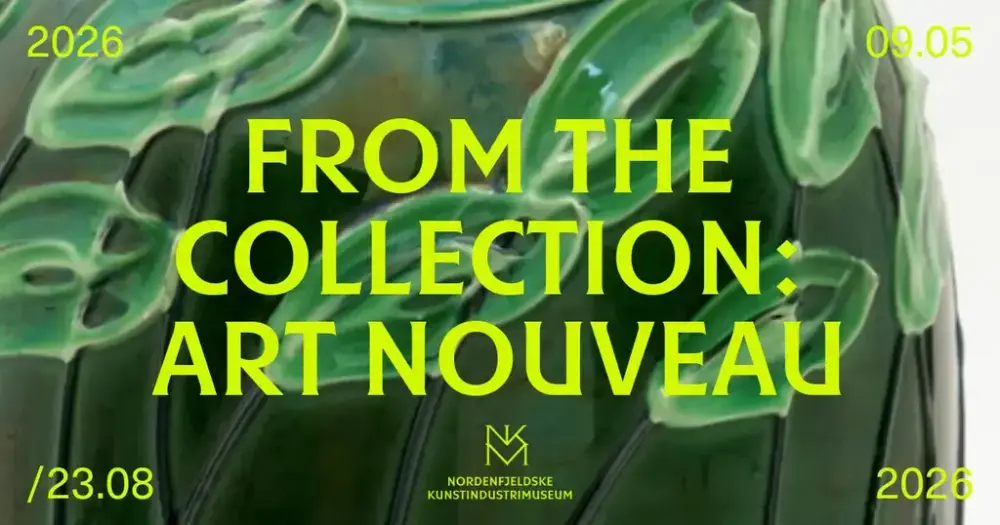
From the Collection: Art Nouveau presents highlights from the Nordenfjeldske Kunstindustrimuseum’s rich collection of decorative arts and design from the period around 1890–1910. The museum was founded in 1893, and its collection was built during a time when Art Nouveau was spreading across Europe.
Art Nouveau emerged as a reaction against both the mass production of industrialisation and the retrospective styles of historicism. Artists and designers sought new forms of expression in nature – in plants, flowers, organic lines and structures that shift between the decorative and the sculptural. In this exhibition, glass, metalwork, ceramics, textiles and furniture come together in a design language that explores nature’s rhythms: twisting tendrils, delicate insect wings, the movement of water and the flowing shapes of tree trunks. Together, these objects demonstrate how nature became a source of both aesthetic renewal and artistic freedom.
After more than two centuries of isolation, Japan opened its borders in the mid‑19th century, and Japanese prints, ceramics and craft objects entered Europe in large numbers. This fascination – known as Japonisme – became highly influential in the development of Art Nouveau. The exhibition therefore includes selected objects from the museum’s East Asia Collection, illuminating how Japanese aesthetics inspired European artists and designers.
One of the museum’s most significant contributions to Art Nouveau history is the iconic interior designed by the Belgian architect and designer Henry van de Velde. Between 1900 and 1907 he created a specially commissioned office interior based on his concept of total design – a unified space in which furniture, decor and architecture form a cohesive artistic whole. The exhibition presents selected pieces from this historic interior. Also on display are lithographs by Edvard Munch, whose graphic work from the 1890s and early 1900s contributed to the stylistic renewal of the period. Munch’s connection to van de Velde offers a unique opportunity to experience these works in a spatial and aesthetic dialogue.
Gerhard Munthe, one of Norway’s most important decorative artists around 1900, also features prominently in the exhibition. Drawing on both Japonisme and European Art Nouveau, Munthe developed a distinctly Norwegian variant through the use of medieval motifs, folk art and mythology. At the museum’s own weaving school, his designs were transformed into large tapestries. One of these, woven by the school’s head, Augusta Christensen, is shown in the exhibition. These textiles illustrate how international influences were translated into a uniquely Norwegian visual language of high artistic merit.
From the Collection: Art Nouveau is a celebration of craftsmanship, of the language of form, and of the historical dialogue between national and international influences. We invite you into the treasure chamber of the collection.